
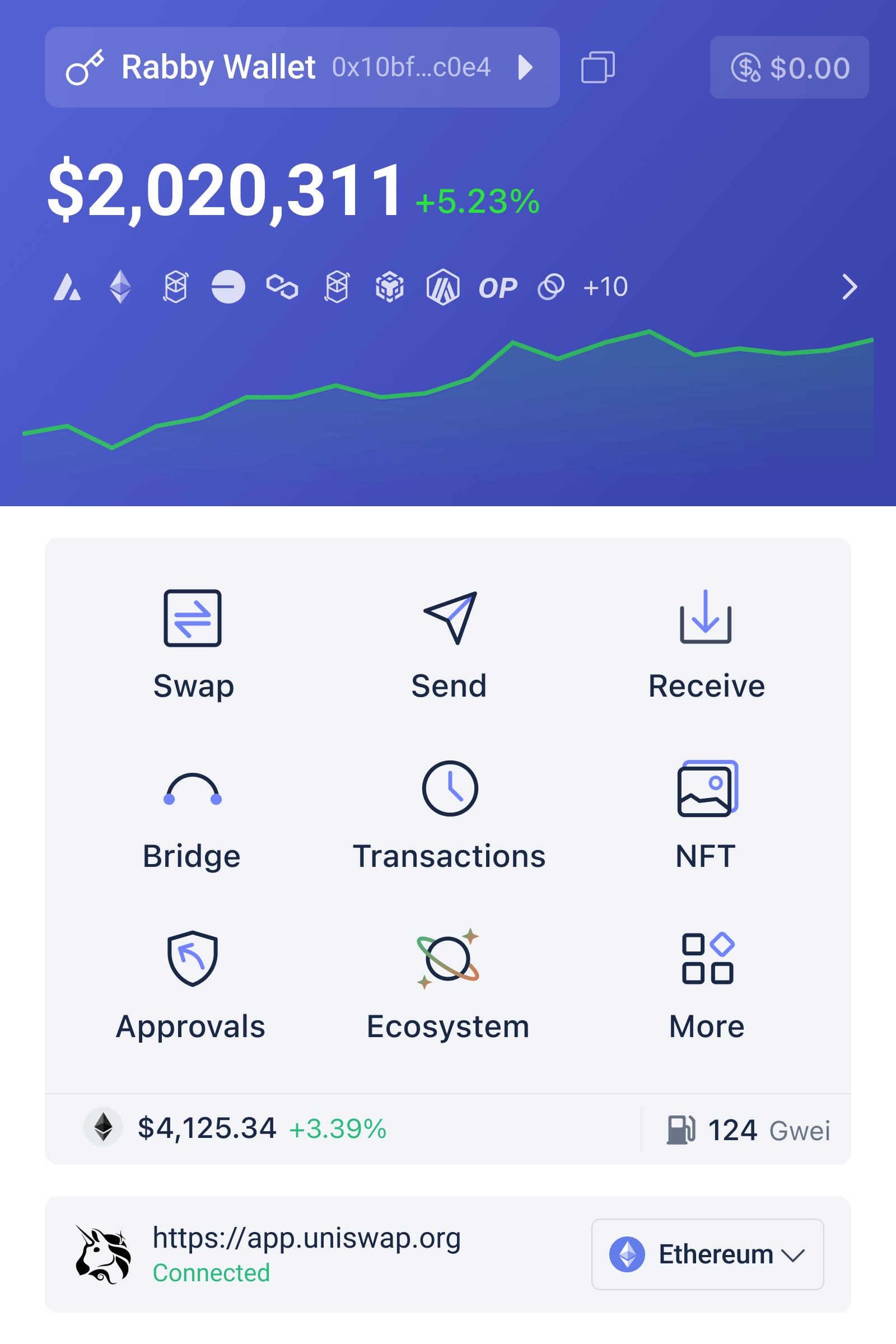
You are about to approve a token swap on Arbitrum, but the wallet window shows more than a vague request to “sign.” It displays the expected balance changes, identifies the network, and warns that an approval could give a contract broad spending authority. This is the practical problem that explains why many users search for “Rabby installieren” or “Rabby Chrome extension” rather than merely looking for another place to store coins. In DeFi, a wallet is not only a key holder. It is also the interface through which a user interprets code, permissions, networks, and financial risk.
Rabby Wallet is designed around that broader role. Developed by DeBank as a non-custodial wallet for Ethereum and other EVM-compatible networks, it combines local key management with transaction simulation, security warnings, automatic network selection, and multi-chain tools. Its appeal is strongest for users who move regularly between ecosystems such as Ethereum, Polygon, Arbitrum, Optimism, Base, Avalanche, and BNB Chain. The important question, however, is not whether Rabby is simply “safer” than every alternative. The more useful question is which risks it can make visible, which operational problems it reduces, and which dangers remain entirely dependent on the user.
Índice
- What the Chrome Extension Actually Does
- Rabby Compared with MetaMask: Different Priorities, Not a Universal Winner
- Why Transaction Simulation Is the Key Mechanism
- Backend Independence and the Limits of “Offline” Security
- Bridges, Swaps, and Gas Accounts: Useful Abstractions with Real Assumptions
- A Practical Decision Framework for German-Speaking DeFi Users
- What to Watch as Multi-Chain Wallets Mature
- Frequently Asked Questions
What the Chrome Extension Actually Does
Installing the Rabby Chrome extension creates a local wallet interface in the browser. The private keys remain on the user’s device under a non-custodial model; they are not sent to Rabby’s servers. When a decentralised application, or dApp, requests an action, Rabby receives the transaction data through the wallet connection and presents it for review. The wallet does not independently invent or modify the transaction. Its central function is closer to an inspection layer between the dApp and the signer.
That distinction matters. A dApp may request a token approval, a contract call, a bridge transfer, or a swap. The contract ultimately determines what the blockchain executes, while the user’s signature authorises the submitted data. Rabby can help interpret this request, simulate expected outcomes, and flag known warning signs, but it does not turn an unsafe contract into a safe one. Users should therefore install the extension only from an official distribution path, verify the application identity, and never enter a seed phrase into a website or chat window. The installation step is part of the security model, not a trivial prelude to it.
Rabby supports more than 140 EVM-compatible chains according to the supplied project information. Its automatic network switching is a meaningful usability improvement: when a connected dApp requires a particular supported chain, the wallet can identify that requirement and switch networks without the user manually searching through a long list. This reduces a common source of friction and some avoidable mistakes. It does not eliminate chain-specific risk, though. A familiar token symbol may represent a different asset on another network, and a bridge transaction still involves separate contracts, liquidity conditions, and trust assumptions.
Rabby Compared with MetaMask: Different Priorities, Not a Universal Winner
Rabby is commonly positioned as an alternative to MetaMask. Both serve as browser-based gateways to EVM applications, support non-custodial signing, and can connect users to a wide range of protocols. The meaningful comparison is therefore not a simple feature count. It concerns the default workflow. MetaMask has broad recognition and extensive ecosystem familiarity, whereas Rabby places more emphasis on multi-chain DeFi navigation, pre-signing analysis, and warnings about contract interactions.
For an occasional Ethereum user who performs only straightforward transfers, the difference may be modest. For a user who supplies liquidity on one chain, swaps on another, bridges assets to a third, and monitors several approvals, Rabby’s transaction-centred design can reduce cognitive load. The wallet’s interface attempts to show the consequence of a request rather than presenting only its technical call data. That is a useful distinction because many DeFi losses arise not from cryptographic failure, but from signing a request whose economic meaning was never understood.
Yet convenience has a trade-off. Automatic network switching, integrated bridges, swaps, and gas services make the wallet more capable, but they also place more financial actions inside one interface. A user may become less deliberate precisely because the process feels smooth. The safest comparison is therefore task-based: Rabby may be a strong fit for active EVM users who value inspection and chain awareness; a simpler wallet may be sufficient for basic transfers; and a hardware wallet remains relevant when the main objective is protecting keys from a compromised computer.
Why Transaction Simulation Is the Key Mechanism
Transaction simulation is often described as a safety feature, but its deeper value is informational. Before signing, Rabby simulates the proposed transaction and presents expected changes to token balances. In practical terms, this can reveal that a supposed “claim” would transfer an asset away, that a swap returns an unexpected token, or that an approval grants a contract the ability to spend more than the user intended. The simulation converts an opaque signing prompt into a provisional economic outcome.
This is also where a common misconception should be corrected: simulation is not a guarantee of safety. It is a forecast of what the transaction would do under the simulated conditions. Results may depend on current blockchain state, available liquidity, contract behaviour, oracle values, block timing, and the precise environment used for the simulation. A transaction can be simulated successfully and still involve a malicious contract, an unfavourable price, a deceptive front end, or a rapidly changing market. Simulation improves observability; it does not remove the need for judgement.
The integrated security engine adds another layer by checking contracts and addresses for indicators such as phishing, known hacks, or potentially unlimited token approvals. These warnings are best understood as risk signals rather than legal or financial certification. A new contract may not yet appear in a warning database, while a flagged interaction may require contextual interpretation. The prudent workflow is to combine the warning with independent checks: confirm the dApp domain, inspect the requested spender, read the approval amount, and consider whether the action is necessary.
Backend Independence and the Limits of “Offline” Security
Rabby’s architecture separates signing from the continued availability of Rabby’s online services. The supplied project information states that core signing functions remain usable even if Rabby servers are unavailable, because Rabby does not create or alter transactions on the user’s behalf. This is a valuable resilience property. It means a service interruption need not automatically prevent access to locally controlled keys or the ability to sign supported transactions.
However, backend independence should not be confused with complete independence from infrastructure. A browser wallet still operates within an operating system, browser, RPC connection, dApp interface, and blockchain network. Security warnings and simulations may depend on available data and services even when the private keys stay local. A compromised computer can potentially expose a wallet session or deceive a user before signing. Local custody reduces dependence on a central custodian; it does not make the endpoint trustworthy by itself.
For larger balances, Rabby’s compatibility with Ledger, Trezor, and OneKey offers a stronger separation between transaction review and key use. A hardware wallet can keep the signing secret in a dedicated device, while Rabby remains the interface for viewing and reviewing the proposed action. This arrangement is not frictionless: users must verify details on the hardware device, protect recovery material, and understand that a hardware wallet cannot prevent a user from approving a malicious transaction. It protects the key more directly than it evaluates the contract.
Bridges, Swaps, and Gas Accounts: Useful Abstractions with Real Assumptions
Rabby integrates cross-chain bridge routes, including protocols such as LI.FI, and provides a swap aggregator that can scan venues such as Uniswap and 1inch. The benefit is operational: users can compare routes or move assets without opening several interfaces. The underlying mechanism remains multi-step. A bridge may involve contracts on more than one chain, intermediary liquidity, relayers, or message-passing systems. A better quoted exchange rate does not automatically mean lower total risk, because smart-contract and settlement assumptions still matter.
The Gas Account feature addresses a familiar problem for multi-chain users: holding the right native token for every network. Paying fees with supported stablecoins such as USDC can make a wallet more usable when a user has funds but lacks the chain’s native gas asset. This is an abstraction over fee management, not a disappearance of fees. Availability, supported routes, pricing, and execution conditions can vary. Users should still retain a deliberate understanding of which chain is being used and how the fee is converted or settled.
Rabby Points, earned through activities such as swaps, gas top-ups, or referrals, add a loyalty layer. Such programmes may encourage engagement, but points should not influence a risk decision. A reward is not compensation for smart-contract exposure, bridge risk, slippage, or an unnecessary transaction. In a disciplined DeFi process, the order is the reverse: first establish that the action is needed and understood, then consider whether any reward is incidental.
A Practical Decision Framework for German-Speaking DeFi Users
A useful rule is to separate four questions before signing. First, identity: am I connected to the intended dApp and chain? Second, authority: what contract and address am I authorising, and is the approval limited? Third, outcome: does the simulation show the balance change I actually expect? Fourth, recovery: if the browser, service, or device fails, do I still control the recovery path? This framework works with Rabby, MetaMask, or another EVM wallet because it focuses on the transaction rather than the brand.
For users in Germany and the wider European market, this discipline also helps separate wallet security from regulatory and tax questions. A non-custodial wallet does not calculate tax obligations, validate a protocol’s legal status, or guarantee that a token is suitable for a particular investor. Records of swaps, bridges, liquidity positions, and fees should be retained independently. Wallet convenience can improve execution, but it does not replace personal documentation or professional advice where the situation requires it.
Open-source software, released under the MIT licence, allows community members to inspect and audit the code, which is a meaningful transparency advantage. Still, open source is not identical to proof that every deployed version is free from vulnerabilities. The relevant questions include whether the installed release is authentic, whether dependencies and update mechanisms are trustworthy, and whether the security signals cover the particular contract being used. These are continuing operational questions, not boxes checked once at installation.
What to Watch as Multi-Chain Wallets Mature
The recent project positioning of Rabby presents it as a general wallet for Ethereum and EVM activity across Web3, with Chrome and Brave extension use at the centre. The likely strategic pressure is clear: as users operate across more chains, wallets must become interpreters of execution rather than passive signature pop-ups. If simulation quality, approval visibility, and chain abstraction continue to improve, the main competitive advantage may shift from the number of supported networks to the accuracy and clarity of risk information.
That scenario depends on difficult conditions. Warning systems must keep pace with new contracts and phishing techniques; simulations must remain intelligible without creating false confidence; and cross-chain convenience must not hide additional trust assumptions. The signal worth watching is not merely another supported chain or integrated service. It is whether users can make better decisions because the wallet exposes the consequences, permissions, and uncertainties of an action before the irreversible signature.
Frequently Asked Questions
How can I install the Rabby Chrome extension safely?
Use the official Rabby distribution channel or a verified browser extension listing, check the publisher and permissions, and avoid sponsored search results or links sent through unsolicited messages. During setup, create or import a wallet only when you understand the recovery process. Never share a seed phrase, private key, or hardware-wallet recovery words with a website, support agent, or extension.
Does Rabby’s transaction simulation make DeFi transactions safe?
No. Simulation can clarify expected token and balance changes and may expose suspicious approvals or outcomes, but it is not a guarantee. Contracts can be malicious, market conditions can change, and a user may still approve an action that is economically inappropriate. Treat simulation as a decision aid and combine it with domain verification, approval review, and sensible position sizing.
Is Rabby better than MetaMask for every user?
Not necessarily. Rabby is particularly suited to active multi-chain EVM users who value automatic network handling, transaction analysis, and integrated DeFi tools. MetaMask may remain preferable for users who prioritise familiarity, existing workflows, or broad ecosystem habits. For substantial holdings, either interface can be paired with a hardware wallet, because key protection and transaction interpretation address different risks.
Where can I learn more before choosing Rabby?
Readers comparing installation steps and wallet workflows can review rabby as a starting point, then verify the current software release and supported features through official sources before installing.

Me dedico a la innovación educativa a través de edtech y metodologías de aprendizaje innovadoras, facilitando los procesos de aprendizaje de personas y organizaciones para disminuir la incertidumbre en la que nos movemos como sociedad, dada la situación de complejidad en la que lo único constante es el cambio. Por ello, considero que la formación y aprendizaje continuo es clave para diseñar nuevo conocimiento que dé respuesta a los retos presentes a los que nos enfrentamos.
Soy experto en Edtech & elearning e Inteligencia Artificial y su aplicación en el sector educativo. Con más de 15 años de experiencia en el sector educativo aplicando metodologías de design thinking y agile a la formación como Chief Learning Officer.
Actualmente lidero el proyecto www.educacionconinnovacion.com y soy Team Leader de IA en Neuroedufit / Opospills, Profesor IA en la educación en el Máster de IA e innovación de la escuela de negocios Founderz y Digital Learning Manager en ISDI, escuela de negocios nativa digital.
Accede a mi Plataforma de aprendizaje sobre Innovación e Inteligencia Artificial: https://campus.educacionconinnovacion.com/